History & traditions
Why Dussehra is celebrated — Vijayadashami in Mysuru and Kullu
The tenth day of victory
Dussehra, or Vijayadashami, falls on the tenth day of the bright half of Ashwin, at the close of Navratri, usually in September or October. In much of North and West India it is kept as the day Rama defeated Ravana, and tall effigies of Ravana, Meghnad and Kumbhakarna are burned in open grounds at dusk. In the east, the same day is the visarjan of Durga. In the south, it is often a day of Ayudha Puja, when tools, books and instruments are honoured, and of beginning new learning.
Two celebrations have become destinations in their own right: Mysuru Dasara, in Karnataka, and Kullu Dussehra, in Himachal Pradesh. They share the name and the season, but they look and feel quite different.
The stories behind the day
As the Ramayana tradition tells it, Rama's victory over Ravana in Lanka was completed on this day, and the return to Ayodhya is remembered later, at Diwali. As the Durga tradition tells it, the goddess's victory over Mahishasura was completed on the same tithi. In Mysuru the royal house of the Wodeyars has, for generations, kept Dasara as a state festival in honour of Chamundeshwari, the form of the goddess who is the city's presiding deity, traditionally believed to have slain the demon Mahishasura on the hill that stands over the town.
These are the accounts as they are traditionally believed and staged. The public meaning of the day, wherever it is kept, is the turning from struggle to a fresh start — which is why so many families also begin a child's education, a new account book or a journey after the puja.
Mysuru's Jamboo Savari, and the gods of Kullu
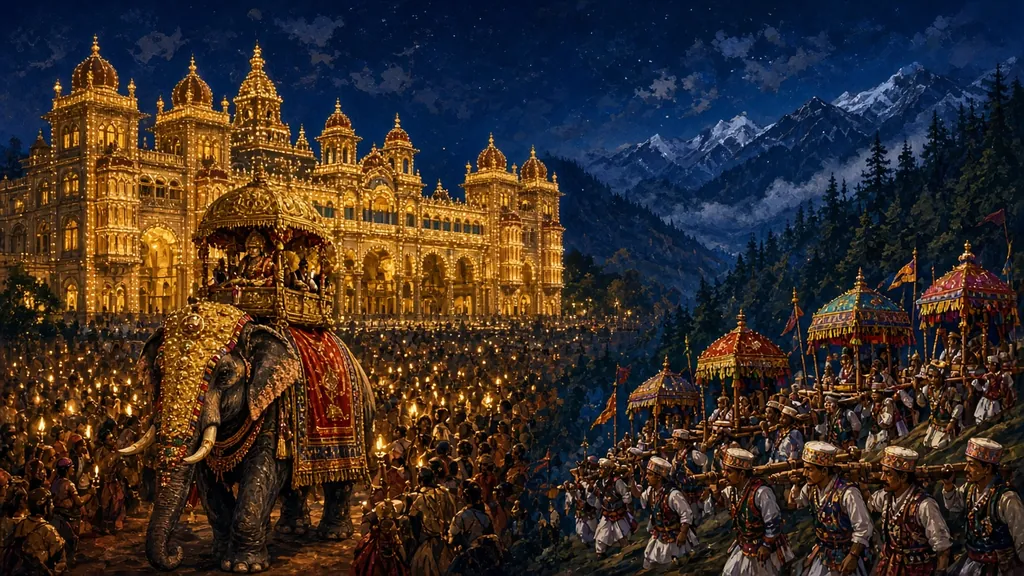
Mysuru Dasara lasts about ten days. The palace is illuminated, there are cultural programmes and a decorated procession of elephants, horses and bands. The climax is the Jamboo Savari, usually on the day after Vijayadashami, when a caparisoned elephant carries the golden howdah with the image of Chamundeshwari through the city to Bannimantap. Crowds line the streets, and the palace and Chamundi Hill are the places people return to each evening.
Kullu Dussehra is unusual because it begins, rather than ends, on Vijayadashami, and then runs for a week in the grassy maidan of Dhalpur. Village deities from the Kullu valley are carried in palanquins to pay homage to Lord Raghunath, a form of Rama, whose rath is pulled in the opening procession. There are no towering Ravana effigies here; the spectacle is the gathering of the devtas against a backdrop of Himalayan hills.
Travelling to Mysuru or Kullu
For Mysuru, the usual way in is to fly to Bengaluru and continue by road or rail, a journey of a few hours; the Jamboo Savari morning is the one to be in town for, and rooms are booked well ahead. For Kullu, fly to Bhuntar (Kullu-Manali airport) or to Dharamshala or Chandigarh and continue by road; the valley is cooler in October, and the week of the mela is busy in both Kullu and nearby Manali. In both places, treat the processional routes as living worship, arrive a day early, and do not expect to move a car close to the main grounds on the climax days.