History & traditions
Why Holi is celebrated — Prahlad, Holika and the colours of Krishna
The festival of colours and spring
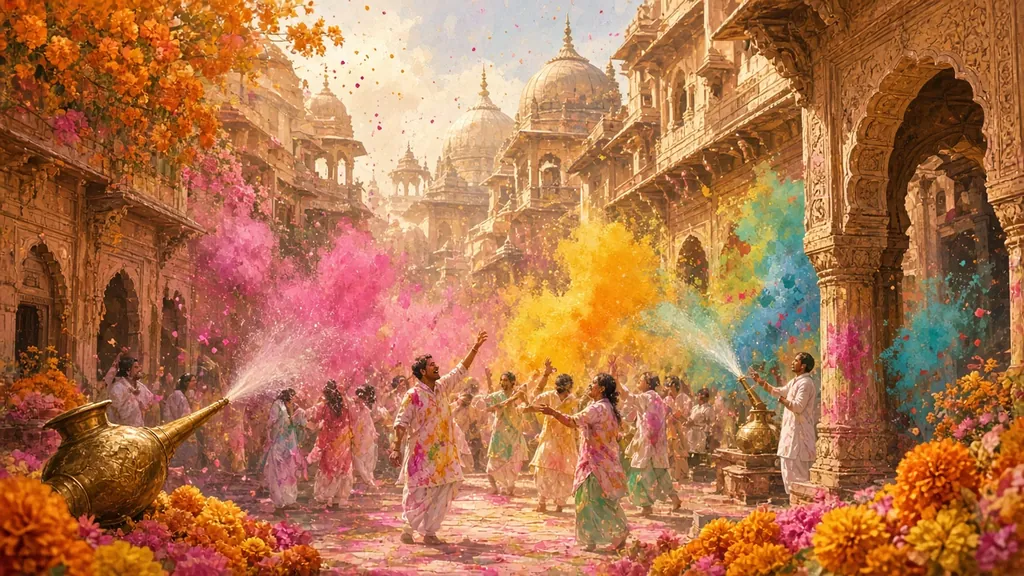
Holi is celebrated on Phalguna Purnima, the full moon of the lunar month of Phalguna, usually in March. It welcomes spring and the ripening of the winter crops, and it is famous for the play of colours, when friends, families and strangers smear each other with gulal and spray coloured water. The evening before is Holika Dahan, when bonfires are lit across North India. In some regions the festival lasts for days; in Braj, around Mathura and Vrindavan, celebrations go on for more than a week.
Prahlad and Holika
The story behind Holika Dahan comes from the Puranas. Hiranyakashipu, a demon king, had won a boon that made him almost impossible to kill and demanded that everyone worship him. His young son Prahlad, however, remained a devotee of Lord Vishnu. After many attempts to kill the boy failed, the king's sister Holika, who was said to be protected from fire, sat in a burning pyre with Prahlad on her lap. According to the story, Holika was burned while Prahlad came out unharmed. Vishnu later appeared as Narasimha, half man and half lion, and ended Hiranyakashipu's tyranny. The Holika bonfire celebrates faith and the victory of good over evil.
Radha, Krishna and the colours of Braj
The playing of colours is closely linked with Krishna. A popular tradition says the young Krishna, who had a dark complexion, worried that the fair Radha would not like him; his mother Yashoda playfully suggested that he colour Radha's face any colour he liked. The play of colours between Krishna, Radha and the gopis became a theme of poetry, song and painting. In Braj, Holi includes Lathmar Holi at Barsana and Nandgaon, where women playfully beat men with sticks, Phoolon wali Holi with flower petals at Vrindavan, and Huranga at Dauji temple.
Holi across India
Other regions have their own forms. In Bengal and Odisha it is Dol Jatra or Basanta Utsav, with swings for Radha-Krishna; Rabindranath Tagore made Basanta Utsav famous at Santiniketan. In Punjab, Sikhs celebrate Hola Mohalla at Anandpur Sahib the next day. In Manipur, Yaoshang is a five-day festival with sports and the Thabal Chongba dance. Some communities in South India mark the day as Kama Dahanam, recalling Shiva burning Kamadeva, the god of love. Across regions, foods like gujiya, malpua, dahi bhalla and thandai are shared, and bhang is drunk by some.
Planning your trip
Holi is a public holiday in most states, and many people travel home or to Mathura, Vrindavan, Jaipur, Pushkar or Varanasi to celebrate. Book early, use natural or skin-safe colours, protect phones and eyes, and respect anyone who does not wish to be coloured.