History & traditions
Why Durga Puja is celebrated — the coming of the Goddess to Bengal
When the Goddess comes home
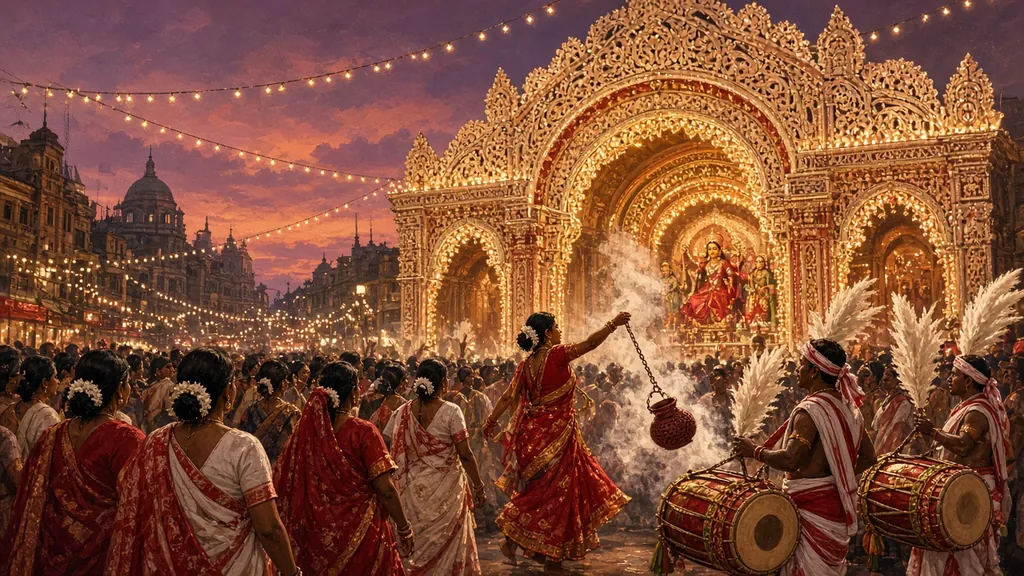
Durga Puja is the great autumn festival of Bengal, and of Bengali communities everywhere. In the lunar month of Ashwin, usually in September or October, an image of the goddess Durga, with her four children — Lakshmi, Saraswati, Kartikeya and Ganesha — and the defeated Mahishasura at her feet, is installed in elaborately built and decorated pandals. The public days run from Maha Shashthi through Saptami, Ashtami and Navami, and close on Vijaya Dashami, when the image is taken in procession for immersion.
For families, the feeling is that the goddess has come to visit, like a married daughter returning to her parental home for a few days, and that the city has been given over to her.
The story of the victory over Mahishasura
As the Devi Mahatmya and later Bengali tradition tell it, the buffalo-demon Mahishasura had become invincible to gods and men. The combined energy of the gods took form as Durga, armed with their weapons, and after a fierce battle she slew him. The image in the pandal, with the lion and the fallen asura, is that moment of victory made visible. It is traditionally believed that she comes from her Himalayan home each year, and that on Dashami she returns.
There is also a Rama story told in some households: that Rama worshipped Durga before the battle with Ravana, and that the autumn puja recalls that untimely, or akoal, invocation. These are sacred tellings, held with devotion, and they stand beside the lived fact of the festival: a whole city looking at art, food, music and the goddess together.
Pandals, dhak and the days of puja
Kolkata is the centre, but the puja is equally alive in the districts of West Bengal, in Assam, Tripura and Odisha, and in Bengali neighbourhoods of Delhi, Mumbai and other cities. From Shashthi the pandals open; people go from one to another, often late into the night, in a slow circuit of looking — at traditional Durga images and at themed, contemporary installations. The dhak drums, the dhunuchi dance with an incense burner, and the pushpanjali prayers of Ashtami and Navami give the days their sound and rhythm.
On Ashtami many households and pandals also perform kumari puja, the honoring of a young girl as a form of the goddess. Dashami brings sindoor khela, when married women apply vermilion to the goddess and to one another, and then the bittersweet visarjan: the immersion, and the greeting shubho bijoya as families visit each other in the days that follow.
Travelling to Kolkata for the Puja
The days to be in the city are Shashthi to Dashami, with Ashtami and Navami the most intense. Flights into Kolkata from Delhi, Mumbai, Bengaluru, Hyderabad and Guwahati fill well in advance, as do trains. Rooms in central neighbourhoods are booked early; some visitors stay a little further out and come in for the evenings. Wear comfortable shoes, expect crowds and temporary road closures, and treat each pandal as a place of worship even when it is also a work of art. If you can stay a day after Dashami, the city is calmer, and the bijoya visits have a warmth that the rush of the peak nights cannot quite hold.