History & traditions
Why Baisakhi is celebrated — harvest, new year and the Khalsa
A harvest and a new year
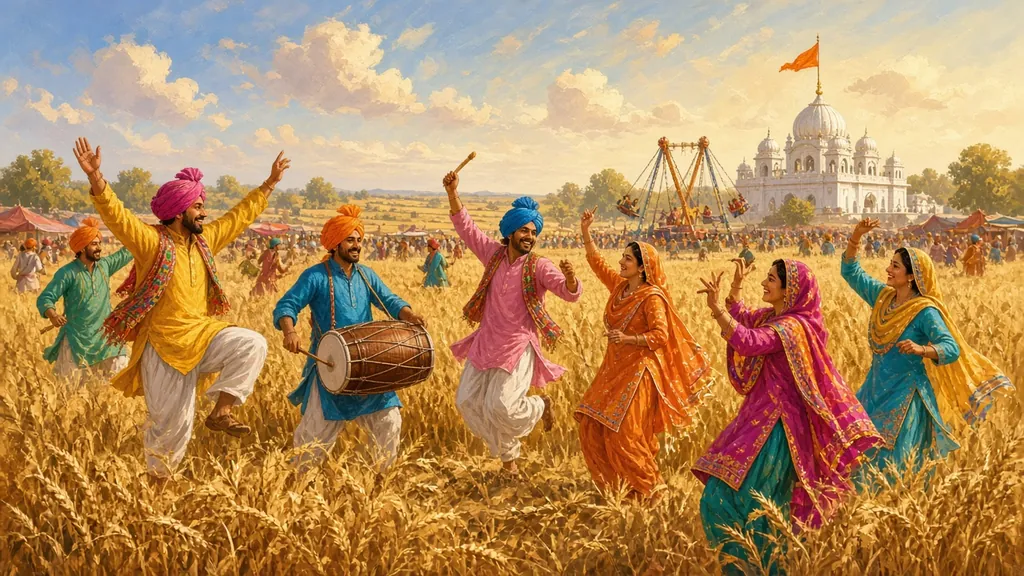
Baisakhi (also written Vaisakhi) falls on 13 or 14 April, on the first day of the solar month of Vaisakh. In Punjab and Haryana it is above all a harvest festival: the rabi wheat crop is golden and ready to cut, and farming families celebrate months of hard work with fairs, bhangra and giddha. The same solar new year is marked across India and South Asia under other names — Bohag Bihu in Assam, Pohela Boishakh in Bengal, Vishu in Kerala, Puthandu in Tamil Nadu, Pana Sankranti in Odisha, and Bisu or Bikhauti in parts of the Himalaya — as well as in Nepal, Sri Lanka and parts of South-East Asia.
The birth of the Khalsa in 1699
For Sikhs, Vaisakhi is one of the most important days of the year. In 1699, at Anandpur Sahib, Guru Gobind Singh Ji called a great gathering of Sikhs. According to Sikh tradition, he came out with a sword and asked who was ready to give his head for the faith. One by one, five men stepped forward — Daya Ram, Dharam Das, Himmat Rai, Mohkam Chand and Sahib Chand — from different castes and regions of India. They became the Panj Pyare, the Five Beloved Ones.
The Guru initiated them with amrit, sweetened water stirred with a double-edged sword, and then asked them to initiate him in turn, showing that the Guru and the Khalsa were equal. With this the Khalsa was founded: a community of initiated Sikhs who keep the five Ks — kesh (uncut hair), kangha (comb), kara (steel bracelet), kirpan (sword) and kachera (undergarment) — and take the names Singh and Kaur. The ceremony rejected caste divisions and is at the heart of Sikh identity today.
Celebrations today
Gurdwaras hold special services, an Akhand Path (continuous reading of the Guru Granth Sahib) ending on Vaisakhi morning, and amrit ceremonies for those who choose to be initiated. Nagar Kirtans — processions led by the Panj Pyare and the Guru Granth Sahib, with kirtan, gatka and decorated floats — fill the streets. The biggest gatherings are at the Golden Temple in Amritsar, Takht Sri Kesgarh Sahib at Anandpur Sahib and Takht Sri Damdama Sahib at Talwandi Sabo. Villages hold fairs with wrestling, food and music.
Remembering Jallianwala Bagh
Baisakhi is also a day of remembrance. On 13 April 1919, thousands of people, many of them visitors to Amritsar for the festival, gathered in Jallianwala Bagh near the Golden Temple. British troops under Brigadier-General Reginald Dyer fired on the unarmed crowd without warning, killing hundreds and injuring many more. The massacre became a turning point in India's freedom struggle, and the memorial at Jallianwala Bagh is visited by many on this day.
Planning your trip
Amritsar is busiest around Vaisakhi, so book flights and rooms early, and expect crowds at the Golden Temple, especially in the evening. April days in Punjab are warm, so carry water and plan sightseeing for the mornings.