History & traditions
Why Onam is celebrated — the homecoming of King Mahabali
Kerala's harvest welcome
Onam is the principal festival of Kerala, a ten-day harvest celebration that usually falls in August or September, in the Malayalam month of Chingam. It begins on the day of Atham and builds towards Thiruvonam, the most important morning, when the household is fully decorated and the sadya, the great vegetarian feast, is served on banana leaves. For Malayali families at home and abroad, this is the week to be together.
The festival is observed by people of many communities in the state. It is as much a cultural new year and a harvest thanksgiving as a religious observance, and its public face — the flower carpets, the boat races, the dances — is shared widely.
The story of Mahabali, as it is traditionally told
The story at the heart of Onam is that of King Mahabali, a generous asura ruler under whom, tradition says, Kerala enjoyed a time of equality and plenty. It is traditionally believed that the gods grew concerned at his power, and that Vishnu came to him in the dwarf form of Vamana and asked for three paces of land. With the first two paces Vamana covered the earth and the heavens; for the third, Mahabali offered his own head and was sent to the nether world.
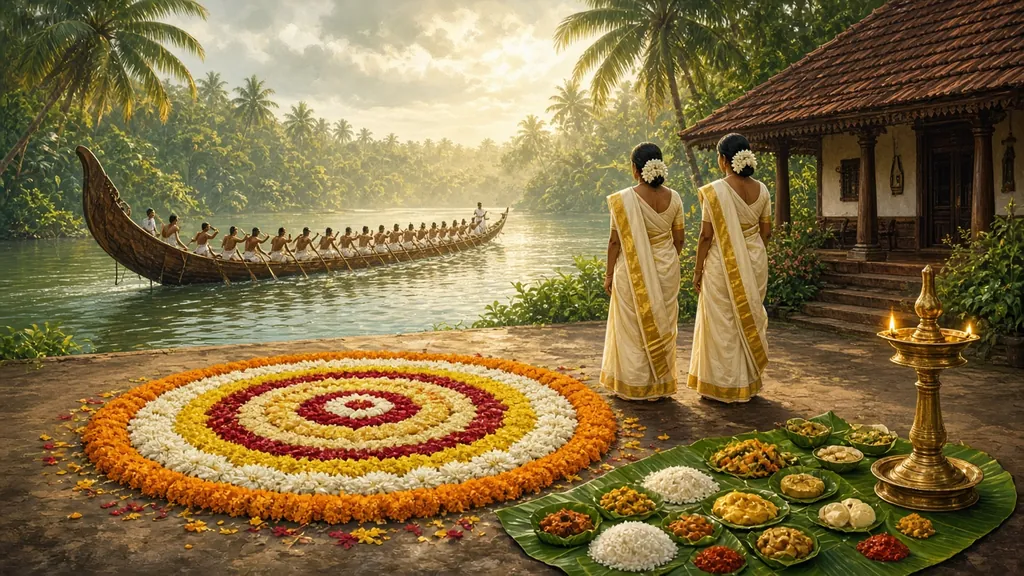
Pleased by the king's devotion, Vishnu is said to have granted him a boon: that he might return once a year to visit his people. Onam is that homecoming. Homes prepare as if a loved king were arriving, and the pookalam — the circular flower rangoli at the door — is laid as a welcome. These are the traditions as Malayali families tell them, kept with affection rather than as a dated chronicle.
Pookalam, sadya and the days of festival
From Atham onwards a pookalam is made each day, growing in rings and colour until Thiruvonam. Women often wear the cream-and-gold kasavu mundu or saree; houses are cleaned and lamps are lit. The sadya is the day's great work: a carefully ordered spread of rice, sambar, avial, olan, kalan, pickles, banana chips, payasam and many other dishes, eaten by hand on a banana leaf.
Public celebrations include the vallamkali snake-boat races on the backwaters, especially in places such as Aranmula and Alappuzha, as well as pulikali — the tiger dance — in Thrissur, and various folk performances. Uthradam, the day before Thiruvonam, is when many people travel and when markets are at their busiest.
Flying home for Thiruvonam
The days to be in Kerala are Uthradam and Thiruvonam: arrive by the previous evening if you can, so that you are there for the morning sadya. Kochi, Thiruvananthapuram and Kozhikode are the main airports, and flights from the Gulf, Bengaluru, Chennai, Mumbai and Delhi are among the first to fill. If you hope to watch a boat race, check the local dates and stay close to the river, because road travel is slow that week. Book early, and treat the feast at home as the centre of the festival — more than any single public event.