History & traditions
Why Maha Shivratri is celebrated — the great night of Shiva
The great night
Maha Shivratri, 'the great night of Shiva', falls on the fourteenth night (chaturdashi) of the dark half of the lunar month of Phalguna in the amanta calendar — Magha in the purnimanta calendar used in much of North India — usually in February or March. Every month has a Shivratri, but this one is considered the most important. Unlike many festivals, it is marked mostly at night, with fasting, prayer and an all-night vigil (jagaran) rather than feasting.
Stories behind the night
Several stories are told, and different regions and communities stress different ones. Many devotees believe it is the night Shiva married Parvati, so temples hold wedding processions and celebrations. Another tradition describes it as the night Shiva performed the Tandava, the cosmic dance of creation, preservation and destruction. A third story comes from the Puranas: Brahma and Vishnu argued over who was greater, and Shiva appeared before them as an endless pillar of fire (the jyotirlinga) whose top and bottom neither could find — the origin of the worship of Shiva as the lingam.
Some also link the night to the churning of the ocean (Samudra Manthan), when Shiva drank the poison halahala to save the world, and his throat turned blue, earning him the name Neelkantha. Devotees keep awake through the night as he was kept awake, so the poison would not harm him. These accounts are not exclusive; most devotees honour Shiva through all of them.
How it is observed
Devotees fast during the day, many taking only fruit and milk, and visit Shiva temples to offer water, milk, honey, bel (bael) leaves, dhatura and flowers on the lingam while chanting 'Om Namah Shivaya'. Worship is often divided into four prahars (watches) through the night. The twelve jyotirlinga temples, including Kashi Vishwanath in Varanasi, Mahakaleshwar in Ujjain, Somnath in Gujarat, Kedarnath (closed in winter) and Trimbakeshwar near Nashik, draw enormous crowds.
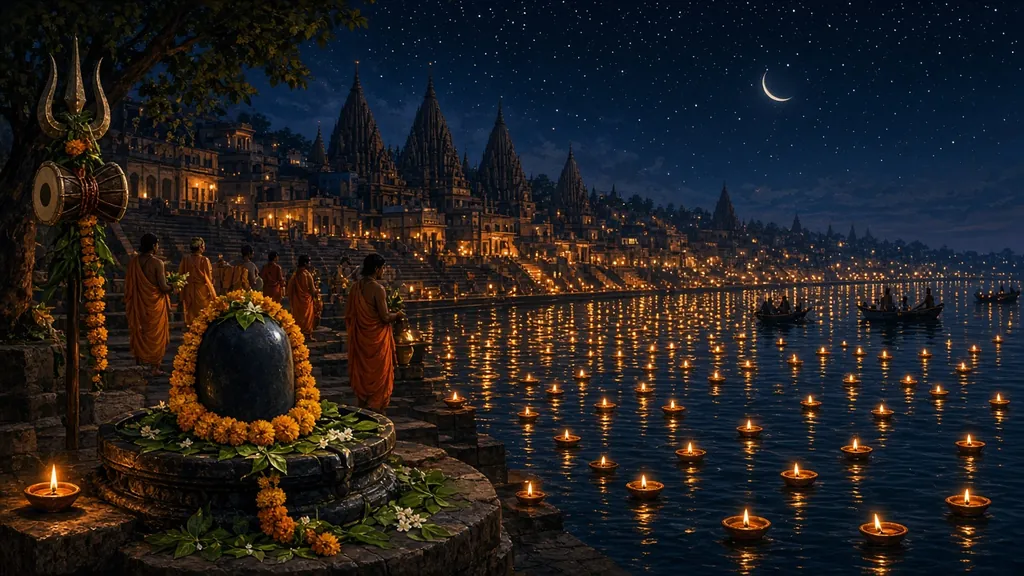
Regional celebrations differ. In Kashmir, Kashmiri Pandits celebrate Herath, one of their main festivals, a day or so before the North Indian date. In Mandi, Himachal Pradesh, a week-long International Shivratri Fair brings village deities in procession. At Junagadh in Gujarat, the Bhavnath fair at the foot of Girnar draws sadhus, and in Nepal the Pashupatinath temple in Kathmandu is the centre of celebrations. Many devotees also travel to Varanasi, where the ghats glow with lamps.
Planning your trip
Temple queues on Shivratri can stretch for hours, and some temples restrict entry or introduce one-way routes. Check the temple's official site for timings and passes, travel the day before, and choose a hotel within walking distance if you plan to attend the night-long prayers. Carry water, wear comfortable footwear you can leave at shoe stands, and keep valuables to a minimum.