History & traditions
Why Janmashtami is celebrated — the birth of Lord Krishna
The eighth night of the dark fortnight
Krishna Janmashtami marks the birth of Lord Krishna, celebrated on the eighth day of the dark half of Bhadrapada, usually in August or early September. The birth is traditionally believed to have taken place at midnight, so many temples and homes keep a day-long fast, sing bhajans, and only break the fast after a midnight puja, when the image of the infant Krishna is placed in a decorated cradle and gently rocked.
The festival is observed across India, with particular intensity in the Braj region — Mathura, where Krishna is said to have been born, and Vrindavan, where he is said to have grown up — and in Dwarka, in Gujarat, the city associated with his later life. Large celebrations are also held in Udupi, in the ISKCON temples, and in towns and neighbourhoods far from those pilgrimage places.
The story as it is traditionally told
As the Bhagavata Purana and later retellings have it, Krishna was born in a prison in Mathura to Devaki and Vasudeva, at a time when Devaki's brother, King Kansa, had been told that her eighth child would be his end. It is traditionally believed that the prison doors opened of themselves, that Vasudeva carried the newborn across the Yamuna on a stormy night, and that he exchanged the child for the baby daughter of Nanda and Yashoda in Gokul. Krishna grew up among the cowherds, and in time returned to Mathura and overthrew Kansa.
These are sacred stories, kept and sung for centuries, and they are offered here as they are traditionally believed. The midnight cradle, the decorations of peepal leaves and flowers, and the little shoes and flute placed before the image all point back to that childhood in Braj.
Cradles, raslila and dahi handi
In Mathura and Vrindavan the days around Janmashtami are filled with temple processions, jhankis and raslila performances that enact episodes from Krishna's life. Homes and shrines display a jhoola, a swing or cradle for the child-god, and offer butter, milk sweets and fruit — the food of the cowherd stories.
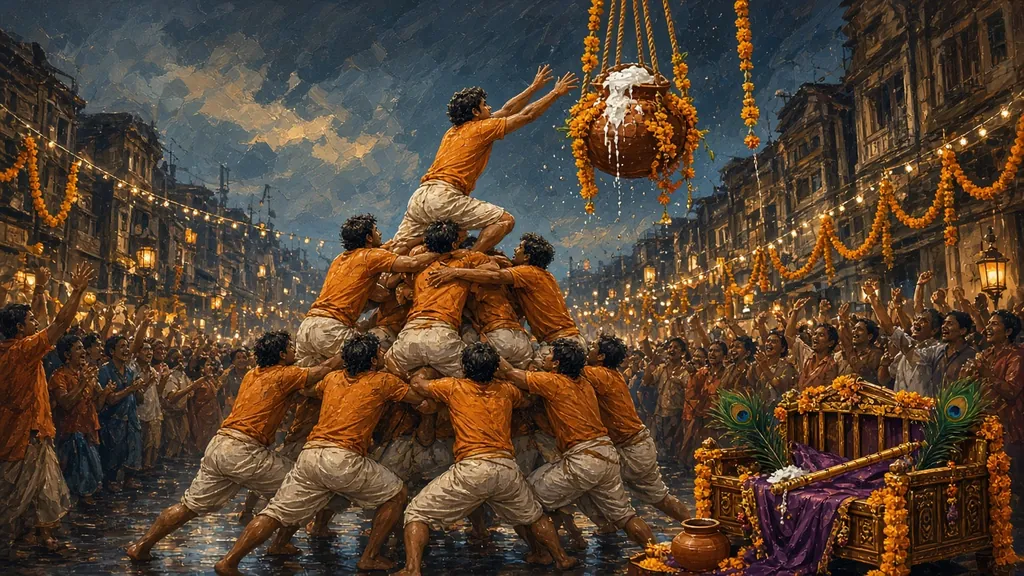
In Maharashtra the day after, or on the festival day itself depending on the local calendar, is famous for dahi handi. Young men form human pyramids in the street to break a clay pot of curd hung high above, recalling the butter-stealing play of Krishna and the gopis. Mumbai's neighbourhood competitions are the most widely watched, and the streets are closed, decorated with marigolds and loud with encouragement.
Travelling for Janmashtami
If you wish to be in Braj, fly into Delhi or Agra and continue by road to Mathura and Vrindavan; the temples are extremely crowded around midnight, so arriving a day early helps. For dahi handi, Mumbai is the place, and the energy is in the lanes rather than in a single shrine — stay close to the neighbourhood you want to see, because moving across the city that morning is slow. Flights into Mumbai, Delhi and the Gujarat airports also fill with people going home for the family fast and the midnight puja. Book early, and plan your return after the morning after, when the city has breathed out.