History & traditions
Why Thrissur Pooram is celebrated — Kerala's great gathering of temples
A pooram at the heart of the city
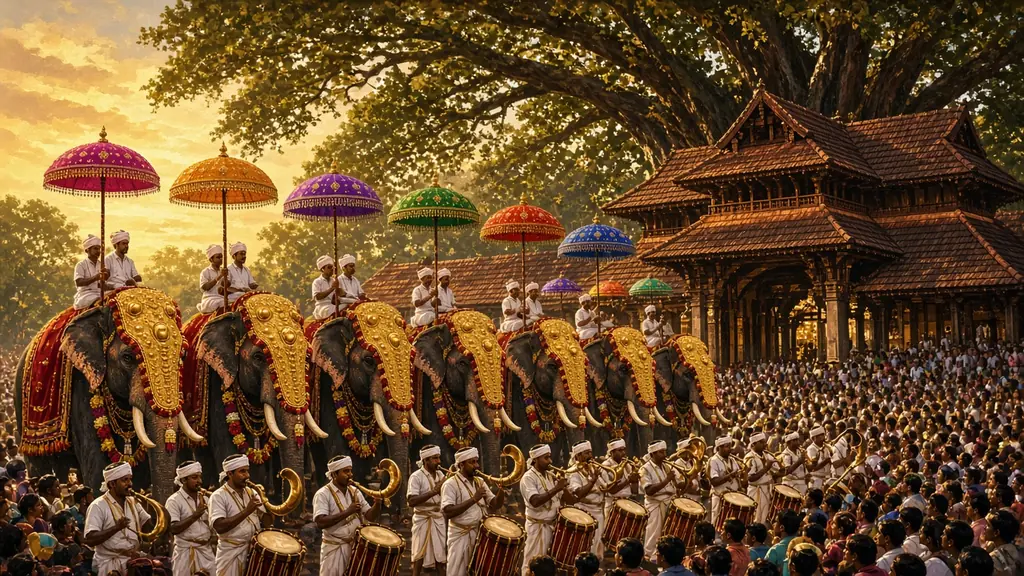
Thrissur Pooram is the best-known temple festival of central Kerala. It is held at the open grounds around the Vadakkunnathan Temple in Thrissur, usually in April or early May, on the pooram day of the Malayalam month of Medam, when the moon is in the star Pooram. Unlike many temple festivals that stay inside one shrine, this is a meeting of several temples in the old town, who come with their deities, elephants, drums and fans to the shade of the great banyan and the temple walls.
Two groups stand at the centre of the day: the Paramekkavu and Thiruvambadi temples, each supported by a cluster of smaller shrines. The gathering is as much a civic event as a religious one: the whole town prepares for it, and people come from across Kerala and beyond.
How it is traditionally said to have begun
It is traditionally believed that the Pooram in its present form was shaped in the late eighteenth century by Raja Rama Varma, known as Sakthan Thampuran, the ruler of Cochin. The story told in Thrissur is that temples of the town had been kept out of a larger pooram at a nearby shrine, and that the raja invited them instead to assemble at Vadakkunnathan, which is dedicated to Lord Shiva, and gave the festival a public standing it has kept ever since.
Whether every detail of that telling can be pinned to a single year is a matter for historians. What is not in doubt is that the Pooram has been the pride of Thrissur for generations, and that its rhythm — the arrival of the processions, the drumming, the display of umbrellas — is treated as an inheritance to be staged with care.
Elephants, drums and the night of fireworks
Through the day, richly caparisoned elephants stand in lines, bearing the temple deities under silk umbrellas. The most famous moment is the kudamattam, when the two sides face each other and change colourful parasols in a swift, competitive display. Before that, the ilanjithara melam — a long, rising performance of chenda drums, cymbals and wind instruments — holds the crowd in a tightening circle of sound.
Late at night, and into the early hours after the main day, the sky over the grounds is given over to a great firework display, which is as much a part of the Pooram as the elephants themselves. The next morning there is a quieter farewell, the pakal pooram, before the visiting temples return home.
If you are travelling to Thrissur
The grounds are densely crowded, and the most dramatic hours are the late afternoon kudamattam and the midnight-to-dawn fireworks. Fly into Kochi (COK), which is the usual gateway, or into Kozhikode, and allow time for the road journey into Thrissur. Rooms in the town are booked well ahead; some visitors stay in Kochi or nearby and come in for the day. Dress modestly near the temple, follow the police and volunteer lines, and be ready for heat, standing room and a very late night.