History & traditions
Why Ganesh Chaturthi is celebrated — the arrival and farewell of Ganesha
Ten days with the Lord of beginnings
Ganesh Chaturthi celebrates the birth of Lord Ganesha, the elephant-headed son of Shiva and Parvati, and the god whom many Hindu families invoke at the start of any new work. It begins on the fourth day of the bright half of Bhadrapada, usually in August or September, and in Maharashtra, Goa, Karnataka and Andhra-Telangana it is kept as a festival of several days, often ten, ending with the visarjan, the immersion of the idol on Anant Chaturdashi.
Homes and neighbourhoods install a clay murti, offer durva grass, modak and other sweets, and sing aarti each evening. The public, neighbourhood form of the festival — the sarvajanik Ganeshotsav — is especially associated with Maharashtra, and it is this form that fills the streets of Mumbai, Pune, Nagpur and many smaller towns.
The birth story, and a public tradition
As the story is traditionally told, Parvati formed a child from the unguent of her bath and set him to guard her door. When Shiva returned and was stopped, a battle followed, and the child's head was struck off. It is traditionally believed that Shiva then replaced it with the head of an elephant and restored him to life, blessing him as Ganesha, first among the gods to be worshipped. There are other tellings in the Puranas; families hold the one they were taught, and all of them honour the same beloved figure.
The large street festival of today has a more recent civic history as well. In the 1890s, the nationalist leader Lokmanya Tilak and others in Pune and Mumbai encouraged a public, collective celebration, so that people could gather openly. That sarvajanik tradition has grown into the vast processions, orchestra-backed mandals and famous murtis — among them Mumbai's Lalbaugcha Raja — that travellers come to see.
From sthapana to the sea
On the first day the idol is installed with a formal sthapana and pranapratishtha, and daily worship continues with offerings of modak, which is traditionally Ganesha's favourite sweet. Some households keep the murti for a day and a half, others for five, seven or the full ten. Each evening the pandals are open to anyone who wishes to take darshan.
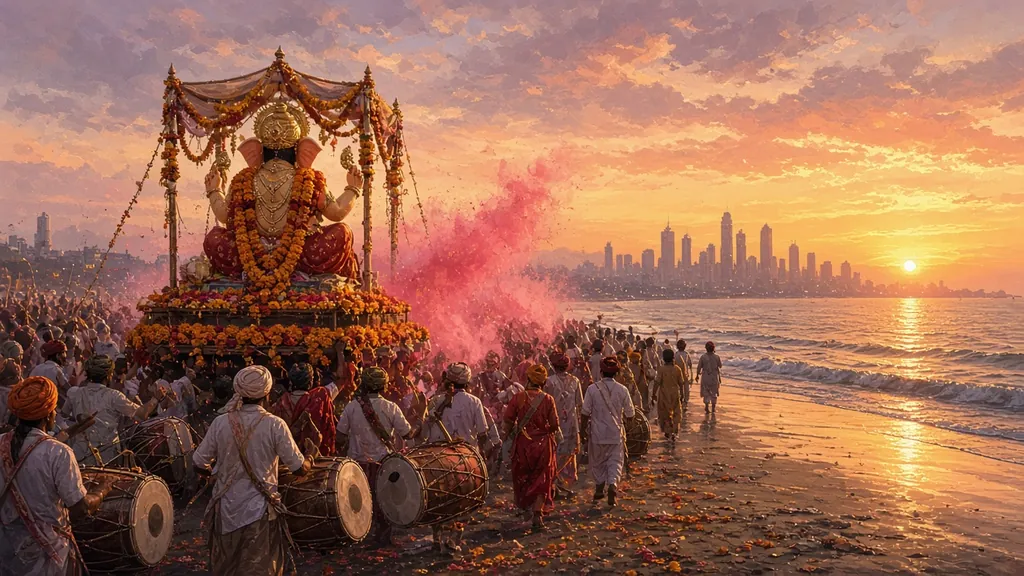
On the final day the idol is carried in a joyful, often dhol-tasha led procession to a river, tank or the sea, with chants of Ganpati Bappa Morya, and immersed with the promise to return next year. In Mumbai the beaches and Girgaon Chowpatty fill for hours; in Pune the immersions move towards the riverside ghats. The mood is festivity and farewell together.
Travelling during Ganeshotsav
Mumbai and Pune are the busiest cities for visitors, but the festival is just as local and heartfelt in towns across the Konkan, Vidarbha and western Maharashtra, and in parts of the south. Flights into Mumbai and Pune fill for both the first weekend and the visarjan. Moving around those cities on immersion day is slow; if you want to watch a visarjan, stay nearby, start early, and keep a respectful distance from the water's edge. Many families also fly home just for the sthapana, and return after a day or two. Book both legs early, and treat the procession as a living act of devotion, not only as a spectacle.