History & traditions
Why Ram Navami is celebrated — the birth of Lord Rama
The birthday of Rama
Ram Navami celebrates the birth of Lord Rama, revered by Hindus as the seventh avatar of Vishnu and the hero of the Ramayana. It falls on the ninth day (navami) of the bright half of the lunar month of Chaitra, usually in March or April, and in many regions it is the last day of Chaitra Navratri, the spring Navratri dedicated to the goddess Durga. Because Rama is said to have been born at midday, the main prayers are often held around noon.
The story in the Ramayana
According to Valmiki's Ramayana, King Dasharatha of Ayodhya had no children and performed a great yajna (the putrakameshti) to pray for heirs. From the sacred fire came a bowl of payasam, which he shared among his three queens. Kausalya gave birth to Rama, Kaikeyi to Bharata, and Sumitra to the twins Lakshmana and Shatrughna. The epic goes on to tell of Rama's marriage to Sita, his fourteen years of exile in the forest, Sita's abduction by Ravana, and Rama's return to Ayodhya, where his rule, Ram Rajya, became an ideal of just government.
The Ramayana has been retold in many languages and forms over many centuries — Kamban's Tamil Ramavataram, Krittivas's Bengali Ramayana and Tulsidas's Awadhi Ramcharitmanas among them — and the stories differ in details. Many Ram Navami traditions draw on the Ramcharitmanas, which is recited in homes and temples during the festival.
How it is celebrated
Devotees fast, visit temples, and listen to recitations and discourses on Rama's life. At noon, many temples rock a small image of baby Rama in a decorated cradle, as at Janmashtami for Krishna. Processions (shobha yatras) with chariots carrying images of Rama, Sita, Lakshmana and Hanuman move through towns. Panakam (a jaggery and pepper drink) and neer mor (spiced buttermilk) are offered in South India, where many temples also celebrate Sita Rama Kalyanam, the divine wedding of Rama and Sita; the celebration at Bhadrachalam in Telangana is among the best known.
Ayodhya and other centres
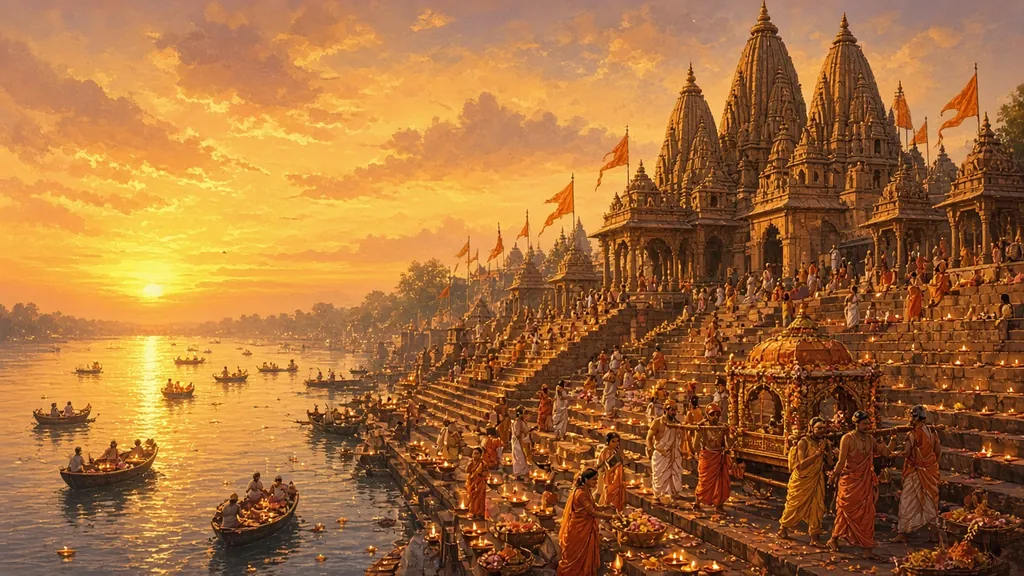
Ayodhya, on the banks of the Sarayu in Uttar Pradesh, is regarded as Rama's birthplace and draws very large crowds, especially since the consecration of the new Ram temple in January 2024. Pilgrims bathe in the Sarayu, visit the temple and Hanuman Garhi, and join the evening aarti on the ghats. Other major celebrations take place at Sitamarhi in Bihar, regarded as Sita's birthplace, at Rameswaram in Tamil Nadu, and in many towns across India where local Ram temples hold fairs.
Planning your trip
Ayodhya now has its own airport, and Lucknow is about a two-and-a-half-hour drive. Book rooms early, as the town fills up for Ram Navami. Temple entry rules and darshan timings can change during festival days, so check the temple trust's official announcements, keep phones and bags to a minimum, and carry water in the April heat.