History & traditions
Why the Rath Yatra is celebrated — when Lord Jagannath comes out in Puri
The day the Lord leaves the temple
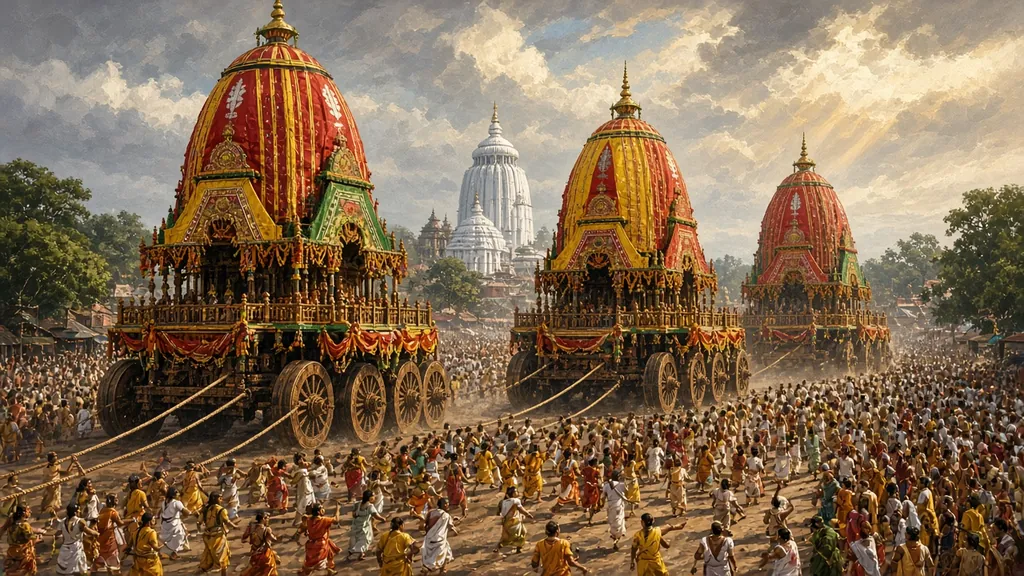
The Rath Yatra of Puri is one of India's great public pilgrimages. Once a year, in the bright fortnight of Ashadha, usually in June or July, the wooden images of Lord Jagannath, his brother Balabhadra and his sister Subhadra are brought out of the Jagannath Temple and placed on three enormous chariots. Devotees pull the chariots along the wide road to the Gundicha Temple, a few kilometres away, where the siblings traditionally stay for some days before the return journey, the Bahuda Yatra.
The three chariots have their own names and colours: Nandighosa for Jagannath, Taladhwaja for Balabhadra and Darpadalana for Subhadra. Each is built afresh every year from specified woods, in a ritual that begins weeks earlier. For devotees, the holiness of the day is that the Lord comes to the street, where anyone may see him.
The story as it is traditionally told
Jagannath is revered as a form of Krishna or Vishnu, and the temple's own traditions are many. One widely told story is of King Indradyumna, who is said to have been instructed in a dream to find a sacred log and to have the images carved from it by a divine carpenter, who asked to work behind closed doors. When the doors were opened too soon, the figures were left in their distinctive unfinished form — large eyes, no clearly carved hands and feet — and that is how they are still worshipped.
The journey to Gundicha is traditionally explained as a visit to a family home, often spoken of as the house of an aunt. These are sacred narratives kept by the temple and by Odia families, offered here as they are traditionally believed, not as datable history. What visitors see, year after year, is the same feeling: a god who lives among his people and comes out to meet them.
How the festival unfolds in Puri
Before the yatra there is the Snana Yatra, the ceremonial bathing of the deities, after which they remain in seclusion for a period called anasara, while the temple prepares new adornments. On the morning of the Rath Yatra the images are brought down the temple steps in a careful, physical ritual known as pahandi, then seated on the chariots. The king of Puri, in the hereditary role of the Lord's first servant, traditionally sweeps the chariot platform with a golden broom — the chhera pahanra — before the pulling begins.
The road fills for hours. Similar Rath Yatras are held in many other towns, and among Odia communities across India, but Puri remains the centre. The return from Gundicha, and the later festivals that close the cycle, keep the town in a sacred rhythm for days after the first procession.
Practical notes for travellers
The usual way in is to fly to Bhubaneswar and continue to Puri by road, a journey of about two hours. The town is extremely crowded on the day of the yatra, hotels are booked far ahead, and movement near the chariots is tightly managed. Arrive at least a day early if you can, carry water, follow the directions of police and temple volunteers, and treat the processional road as a place of worship rather than a vantage point to be rushed. If your dates are flexible, the quieter days of the stay at Gundicha have their own devotion, with less of the pressure of the main morning.